

 Teach English in Asia
  Cruise Ship Jobs
  Alaska Fishing Industry Jobs
  Sharing Economy / Gig Economy
 Alaska Fisheries Management – Controlling the Harvest
Not everyone who owns a boat has the right to venture out into coastal waters and fish for commercial gain. The Alaska Department of Fish and Game and other agencies regulate the fishing industry by two methods: limited entry and Individual Fishing Quotas (IFQs).
Limited entry refers to the permit process each boat owner must undergo before being able to fish legally in Alaskan waters. A set number of non-expiring fishing permits were issued years ago. Each permit gives the owner the right to harvest a certain type of fish in a specific region, which means that a holder of a herring permit can’t fish for salmon, for example. Owners of these permits are allowed to sell them on the open market, enabling new fishermen to enter the industry. The price of entry doesn’t come cheap; depending on the region and type of fish, a permit can sell for as much as $300,000.
By limiting the number of permits issued, the state can assure that fish stocks don’t become too depleted, as happened to several fisheries before the permit system was implemented. Since there are a limited number of fishing vessels in a particular area, fishermen are assured of limited competition and a steady flow of fish during the season. The limited number of boats in each fishery can also make fishing very lucrative. With limited competition from other boats and a well-managed fish population, deckhands on some of the better boats make well over $8,000 a month, depending on the catch.
Individual Fishing Quotas are a relatively new system for controlling harvests in the halibut and groundfish industry. Under this system, fishing for halibut and sablefish is limited to boats which have been granted IFQs. An IFQ grants a quota of fish to each boat for the entire season, and these fish can be caught during most of the year. Previously, many more boats were allowed to fish but were limited to very short, sporadic seasons. The section on halibut fishing provides more information about how the IFQ system influences available jobs in the Alaska fishing industry.
The Department of Fish and Game strictly regulates fishing seasons by patrolling crowded fishing areas and using data collected by domestic observers posted on selected fishing vessels.
The department continually announces opening and closing dates for particular fisheries. Depending on the fishery and region, boats are strictly limited to a certain number of days (sometimes hours) they can fish in a given season. Some fisheries are year-round; others are only open for a number of days or hours. For example, a salmon gillnetter in Southeast Alaska generally fishes one or two 12 or 24-hour openings a week during the summer months, while salmon trollers get to fish almost every day. Of course, trollers generally catch fish at a far slower rate than gillnetters. During the herring season, there may only be a single opening for the whole year.
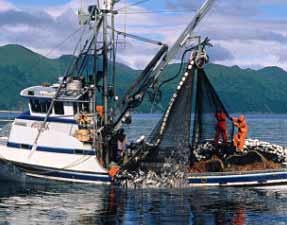
Many herring openings for the purse seiner fleet last for less than 12 hours as boats swarm over hot spots trying to catch as many fish as possible in only half a day!
These regulations are strictly enforced for good reason. They help to ensure that overfishing does not occur and that there will be healthy harvests and satisfied fishermen for many years to come.