

 Teach English in Asia
  Cruise Ship Jobs
 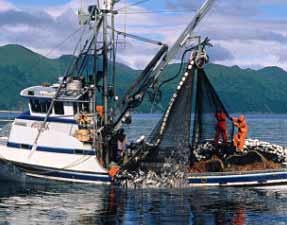 Alaska Fishing Industry Jobs
  Sharing Economy / Gig Economy
 Factory Trawler Processing Jobs
Factory workers – also known as “slimers” – are the positions in which most first-timers in the industry begin. Factory workers spend twelve hours a day (on some boats, sixteen hours), seven days a week repeating the same repetitive motions. Here’s list of the many types of jobs on a typical Alaska factory trawler:
- Sorter: The sorter pulls the non-targeted fish, or by-catch, from the fish species being processed. This must be done very quickly to ensure that the rest of the factory never runs out of fish to process.
- Fillet machine operator (driver): This is one of the most common positions on a factory trawler. Once the fish are sorted, they come up a conveyer belt or through a hydraulic door to a table or belt in front of the driver. The driver grabs the fish and places them in trays that are moving very quickly between the driver and the fish that are being grabbed. The fish are then sent to the filleting machine, commonly a Baader 182, which can fillet 145 fish per minute. The driver must learn to fill every one of these trays. A missed tray means lost production, and lost money for both the company and workers. To grab 145 fish, and place them all uniformly in 145 trays, every minute, for twelve to sixteen hours every day, takes a lot of mental patience. That is over two fish every second. But anyone with enough desire to work on a factory trawler can learn to do it.
- Flippers and candlers: Next, the fillets go to a table belt that is lit from underneath by fluorescent lights. Here one processor, the “flipper,” quickly straightens all the fillets. Next to the flipper, processors known as “candlers” inspect the fillets for bones or parasites (worms). Fillets passing inspection are then placed in trays to be frozen. These positions are only on those boats that freeze whole fillets as a product, known commonly as “block” or “shatter-pack.” If only surimi is made, the trawler will not have these positions.
- Extruders: If the boat makes surimi, then it will have a few extruding positions in the factory. The extruders are processors at the end of the surimi line that mix sugar or other sweeteners in with the finished surimi paste, and then place the mixed surimi in bags and pans to be frozen.
- Roe cleaners, sorters, and packers: Pollock A season (begins in January) is also known as roe season. Trawlers that catch and process Alaska pollock also extract the roe from the fish, which are at this time spawning. On some of the boats, processors cut the roe from the fish with knives by hand, known as “hand-stripping.” Most of the trawlers, however, now have machines that automatically pull the roe from the fish. Once the roe is extracted, processors must separate the roe from other fish innards that the machines also have extracted. The roe is then hand-sorted by size and quality before being sent to the packers, who wrap the roe in plastic, and place it in pans to be frozen.
- Freezer crew: No matter what the product of the trawler is – fillets, surimi, or roe – it must all go to the freezer. The freezer crew is divided into a few different positions. The “loader” takes the pans of finished product and places them in plate freezers. After freezing, the “freezer breaker” takes the pans back out of the freezer and sends them to the “pan breaker,” who breaks the product out of the pans. The product, still wrapped in plastic, then goes to “case-up,” where it is put into boxes stamped with the product grade and date. These boxes are glued or taped shut, and sent to the “stacker” who stacks the product in the freezer hold.
None of these jobs requires previous experience. But all require hard work, concentration, determination, and desire. At times, the pace may slow to a crawl, but typically it is hectic. Workers on a factory trawler live by the motto “Time is Money.” That’s why most of them are there anyway, to make money.
Working on the production line is very monotonous.
But it can also be fun. One can make some good friends on the boat, and a sense of humor will certainly help pass the time.
A processor’s pay varies from boat to boat. It ranges from $3,000 to $6,000 a month. And after working for a while and getting a couple of raises, earnings can be as high as $8,000 a month. Significantly better than your local fast-food restaurant!
Cook’s helpers (galley help)
If you have ever fantasized about subjecting a captive clientele of seventy-five half-starved people to institutional food, this job is for you. Between one and three assistants help the cook chop vegetables, mix ingredients, wash dishes, etc. They also help plan meals, keep a record of stock levels, and purchase more supplies when ashore. Prior experience with institutional food service is helpful, but not necessary.
A cook’s helper gets approximately the same pay as a factory worker ($3,000 – $5,000 a month), but usually raises come less frequently. The work is definitely more pleasant than in the factory, being less monotonous, and galley helpers don’t have to wear rain gear. The end result is lower pay and fewer raises.