

 Teach English in Asia
  Cruise Ship Jobs
  Alaska Fishing Industry Jobs
  Sharing Economy / Gig Economy
 Alaska Halibut Fishing Jobs
Pacific halibut are a firm, highly valued whitefish easily identifiable by their large, flat bodies and eyes on the top of their head. This peculiar adaptation allows the halibut to camouflage itself – white side down, brown side up – on sandy or gravelly areas against the floor of the continental shelf. Although most 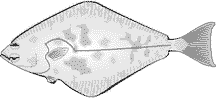 harvested halibut weigh between 20 and 80 pounds, fish weighing over 250 pounds are not uncommon. The largest halibut on record was more than 12 feet long and weighed well over 600 pounds.
The world’s most productive Pacific halibut nurseries are in the Gulf of Alaska, and although its habitat extends all along the Pacific Coast, over three-quarters of U.S. and Canadian commercial halibut harvests occur in Alaska waters.
During the late 1970s, halibut harvests in the North Pacific fell to all-time lows, bottoming out in 1977 at under 17 million pounds. Since then, because of stricter regulations, improved management, and the exclusion of Japanese factory trawlers from halibut nursery areas, the species made a solid comeback. Halibut harvests have been consistent in recent years.
The season used to consist of a few openings per year for 24-48 hours at a time. Full quotas for each district were reached in a matter of days or even hours. Hundreds of converted boats joined the halibut fleet to fish these short-term “derbies.” This ultimately resulted in instantaneous floods of fish on the market, lower prices, less profitability for fishermen, and less than fresh produce for consumers. To make matters worse, halibut stocks went into a deep decline. The widespread use of more effective roundhooks and larger, automated boats pressured stocks.
The IFQ System
In response to problems in the halibut and black cod fisheries, the North Pacific Fishery Management Council (NPFMC) instituted a new method of regulating the harvest, which is known as the IFQ (Individual Fishing Quota) system. Prior to the IFQ, which took effect in 1995, the halibut and black cod fisheries were managed according to a Total Allowable Catch (TAC) system, but the fisheries were over-commercialized: there were too many boats trying to catch a set number of fish (TAC) in an unregulated amount of time. Under this system, the seasons might have lasted as few as 48 hours, prices were low, and safety and environmental concerns were not closely monitored. Under the new system, Individual Quota Shares (QS) for each area are pooled and a percentage of that pool determines the IFQ for individual vessels. Rather than having short-term derbies in which the total TAC is caught, IFQs allow captains to fish over a period of months and thus wait to fish until prices and weather conditions are just right.
The IFQ system was set up so that QS can be leased, bought, or traded. Initially there were concerns that the IFQ would allow a small number of vessels to purchase a large number of QS, thereby controlling the fishery and significantly reducing the number of boats; however, NPFMC instituted a number of constraints that keep such a monopoly from occurring so that the fishery will continue to be owner-operated and open to new competitors. There is now a trend toward crew members buying QS so that they’ll be more attractive to vessel owners. When the QS are combined, the IFQ for the vessel increases: more fish can be caught and more money can be earned.
What does this mean for you as a job seeker? Well, the days of landing a job for one week aboard a halibut boat and earning $8,000 for a week of fishing are over. Most longlining vessels are hiring smaller full-time crews, but since the season lasts several months there is still a degree of crew turnover. The actual number of vessels hasn’t decreased significantly, so opportunities are available for those with experience, commitment, and ambition.