

 Teach English in Asia
  Cruise Ship Jobs
  Alaska Fishing Industry Jobs
  Sharing Economy / Gig Economy
 Alaska Herring Harvesting and Processing Jobs
The annual herring harvest comprises two main products – sac-roe , and roe-on-kelp. Herring for bait, low-cost food, and fertilizer are industry by-products and account for only about one percent of the annual harvest value. Success in the sac-roe herring business is largely a matter of timing. Prices depend on the percentage of females in each haul, the percentage of roe content by weight, and the maturity of the eggs. Ideally, adult females should be harvested just before spawning and roe should comprise 12-15 percent of the total weight.
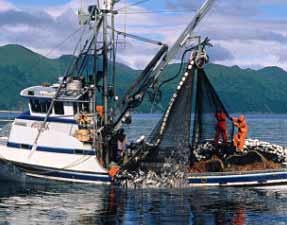
The roe harvest usually involves either gillnets or purse seine nets. Gillnets are either anchored in shallow water or allowed to drift in migration areas, entangling fish by the gills. Purse seines, on the other hand, are offshore nets set in a fence-like configuration around a targeted school of fish. Once the fish are encircled, the bottom of the net is drawn in and gradually pulled on board. Finally, a pump pulls the fish out of the net and on board.
In March, the sac-roe herring season begins in Southeast and gradually moves north over the next three months. The sac-roe industry has become extremely lucrative and restricted, so finding work on a sac-roe boat can be difficult. In this fishery, deckhands often make $4,000-plus for a few hours of fishing. Those seeking a position should have offshore fishing experience and considerable persistence.
Roe-on-kelp is dried raw kelp coated with accumulations of herring roe. It can be harvested from natural kelp beds in the sea, kelp-bearing longlines set in herring spawning areas, or man-made kelp ponds, into which spawning herring have been released.
Certain kelp beds are off-limits to all but Alaska Natives, who depend on seasonal supplies of roe-on-kelp for subsistence; however, naturally occurring roe-on kelp is harvested commercially in the Southeast, Prince William Sound, and Bristol Bay. Those interested in harvesting roe-on-kelp should begin by checking these areas before the season begins in April.
Processing Herring
Herring are processed mainly for their eggs. The actual processing of herring roe is very similar to the processing of salmon roe.