

 Teach English in Asia
  Cruise Ship Jobs
  Alaska Fishing Industry Jobs
  Sharing Economy / Gig Economy
 Year-Round Alaskan Fisheries – Bottomfish, Cod, Pollock, More
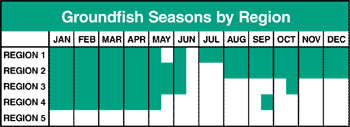
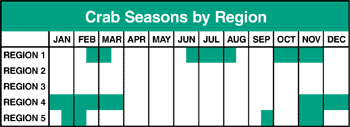
During the summer many fresh frozen plants process cod, sablefish, snapper, and other species of fish concurrently with salmon; however, the majority of this processing occurs during other times of the year. Crabbing, halibut, groundfish, herring, and shellfish harvests (see charts) combine to provide many onshore processing plants with year-round work.
Bottomfish Jobs
Bottomfish processing is far more automated than salmon processing, but still requires quite a few workers in the inspection, freezing, and packing phases. Most flatfish are simply put in a block and frozen whole. Another common process is to take the head and tail off, leave in the guts (called kirimi), and then freeze the fish. Flatfish are difficult to fillet by hand, so that stage of the process usually waits until the fish gets to the retailer or restaurant.
 |
Cod Jobs
Most processing is done either at onshore plants or on board factory trawlers, factory longliners, and floating processors. First, the head is removed by an automated cutter and then the product is filleted by a fillet machine (two pieces). The skin is removed by an automated skinner. After skinning the fillets, the flesh is run by bright lights and inspected for defects in a process called candling. Other workers remove the remaining bones and dress up the fillets by cutting out bad areas. Next, they’re frozen by a variety of methods, including IQF (individually quick-frozen) on a quick-freezing belt, or shatter-packed (putting plastic between layers of fillets and then freezing), or blocked by placing them in cardboard boxes about two inches thick. Blocked cod usually goes to a fish-stick plant after freezing.
Pollock Jobs
Pollock is processed into both surimi and fillets, in about a 50/50 split. Fillets are made in a process identical to that for cod. For surimi, first the fish are filleted, then minced, washed thoroughly in fresh water and pressed to remove any liquid. The resulting paste-like substance is put in batter and mixed with moisture-retentive agents and anti-oxidants. Then it is extruded from a mixer and into a freezer pan, and a block of surimi is produced. Some plants remove more flesh from the backbone, and send it through another surimi line that produces a lower-grade product. This process only requires two people to load on the front end and two more to smooth the freezer pan and load. The majority of surimi processing is done in Kodiak, Dutch Harbor, and on floating processors and factory trawlers.
Halibut Jobs
After being gutted at sea, this giant fish is processed into two forms. In the primary form, the head is cut off at the dock and the cheeks are cut out and sold separately. The fish is then weighed, washed, and frozen whole. If the halibut is over 120 pounds it’s “fletched.” A fletch is a special way of dividing the halibut so it yields four fillets for each fish.
Alaska Crab Jobs
 |
Crab processing is different, and actually quite a bit simpler than fish processing. Here’s an overview of how it works:
- First the foreman or his assistant uses a giant crane to load crabs off the crabbers and onto the processing boat. Most crabbing is done during the winter months, and working at an off-loading job may mean being exposed to cold and wet conditions.
- The first people to handle the crabs are the butchers, who ram the crabs against a stationary blade that separates the shell from the rest of the crab and rips the legs off the body.
- The legs are thrown into a big bin. Workers known as gillers remove them from the legs with a metal brush apparatus.
- The legs are then stacked in big wire cages and lowered into a cooker tank by the cooker, who then removes them from the tank.
- The cooler worker then slides the cages into the cooler tank, which is a long basin of cold water that holds several baskets of crabs at a time. The crabs sit in the tank to cool off for a few minutes before being removed and put into the brine tank, which contains very cold salt water.
- The legs freeze inside the salt water, and are removed and put in containers by boxers.
- The boxes are then placed inside the freezer by the freezer crew, and are ready for off-loading to freighters.
- Quality-assurance people work to maintain and insure product freshness and overall quality.
A worker on a crab vessel pointed out that while the work is steady, it’s not overwhelming:
- “The pace of work is basically set by the assembly line and is kind of limited by the cooking machinery, since only a certain number of crabs can be cooked at one time. The pace isn’t real fast, but you are definitely expected to keep up, which everybody manages to do.”