

 Teach English in Asia
  Cruise Ship Jobs
  Alaska Fishing Industry Jobs
  Sharing Economy / Gig Economy
 Ski Patrol Issues
Hazards
One of the hazards of patrolling is dealing with the accident victim who is in denial. The person may have a broken leg, a bleeding head, or a dislocated shoulder and still deny that they need any help. People in this situation can be belligerent, but just like the firefighter who responds to a fire emergency, the patroller must own the scene. There’s a story of a misguided fire victim who stood in the window of a burning apartment building and tried to wave the fire truck away, saying everything was fine and no help was needed, thanks. Would the firefighters say, “Okay, no problem here; let’s go home”? No way. But denial adds to their problems. It takes training, confidence, and sheer guts to take charge of situations in which people are in shock and denial. Sometimes taking charge comes down to telling the victim, “Hey, you big baby, let’s grow up and deal with the reality of the situation here.” Often, letting the victim know that you’re capable and in charge removes the burden of responsibility from their shoulders and allows them to let you help them.
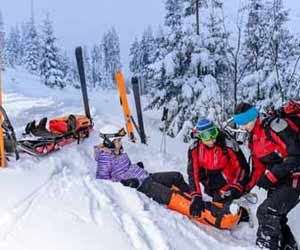
Sometimes taking charge means contradicting the doctor who may show up at the scene, since doctors on volunteer patrol aren’t always up to speed on emergency procedures. In one instance, an orthopedic surgeon responded to a radio call, diagnosed the victim as having a dislocated shoulder, and was about to pull on the victim’s arm in an attempt to snap the shoulder back into its socket. The ski patroller on the scene stopped the doctor just in time. As the patroller suspected, the victim’s arm turned out to be broken just above the elbow.
As more doctors and more medical supplies are in place at ski areas, the incidences of “improvise any way you can” happen less and less often. But in times past, when the patrol was getting its start, very inventive solutions to medical emergencies took place.
One Northwest doctor was known to use any available resource to staunch a medical problem. At an auto accident scene on the way to the ski area one morning, he performed an emergency tracheotomy using one of the car’s vacuum hoses.
In the absence of the right tools for the job, another doctor stapled an ear back in place. The injured man still has the ear today.
— View Ski Resort Job Postings —
Work Schedule
What might a patroller do in the off season? Many of them stay at the resorts and work as summer guides for bikers and hikers, or nab a job in retail, or sling chow in restaurants.
Many are expert mountaineers and spend spring and summer climbing peaks south of the equator.
Dave Hahn is a ski patroller at Taos Ski Valley in New Mexico. In the spring of 1994 he was a guide on the U.S. International Mountain Guides expedition to Mt. Everest. One good break led to another, and Hahn managed to summit on his own after performing a high-altitude rescue.
Hahn says he is often asked about the physical aspects of working as a mountain guide and ski patroller:
“Physically it wasn’t as much as I’d done in other circumstances, like on patrol. Mentally, that’s where it really challenged me – kind of a mental stamina test. It would be anyway up there because you have to be very focused. The route is not obscenely difficult, but you don’t miss a step with a 9,000-foot drop below you.”