

 Teach English in Asia
  Cruise Ship Jobs
  Alaska Fishing Industry Jobs
  Sharing Economy / Gig Economy
 Facts About Indonesia
Population
Five main islands and thirty smaller archipelagos are home to almost 250 million people, nearly 60 percent of whom live on Java.
Geography
Indonesia, like many island strings, was formed by volcanic activity.
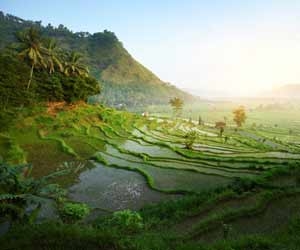
What’s exciting about the landscape in this country is that many of these volcanoes are still active. For the visitor, the mountainous terrain can be both a blessing and a curse. You’ll have the chance to climb active volcanoes, peer down steep overlooks to rice and tobacco fields below, and float on the largest crater lake in the world. On the other hand, constantly having to lug a heavy backpack up a steep hill to get to your losmen and riding cramped buses over roller coaster-like hills with motion sickness-prone locals can wear you thin after a while.
Climate
Indonesia has a tropical climate with two distinct seasons depending on how far west or east you are: hot and dry, and hot and wet. The rainy season, when the monsoons hit, usually begins in September and ends in April. The hottest months are May through August. Year-round temperatures range from the 70s to 90s Fahrenheit (20s to 30s Celsius), and average humidity can get above 75 percent during the rainier months! The temperatures at higher elevations are typically cooler.
Politics
When a coup attempt was made in 1965, a General Suharto organized troops and successfully thwarted a takeover. The message that Communists were behind the plot fit in perfectly with Indonesia’s fear of the party (especially strong since a failed Communist takeover in 1948). In subsequent years, however, a number of theories have surfaced incriminating the CIA, the Indonesian government, and Suharto himself in the 1965 incident. Nonetheless, and despite recent economic and political unrest, Suharto continues as head of the country. You should avoid speaking of politics at all – Indonesian or U.S. – as the topic is very controversial and is likely to elicit strong feelings in most individuals.
Religion
Islam is the predominant religion of Indonesia, with Christian populations in some regions (notably Flores and the Lake Toba area of Sumatra) and one island that is Hindu (Bali). Jakarta is home to the largest mosque in Southeast Asia, and signs of Islam are present nearly everywhere you go, from the daily calls to prayer broadcast over loudspeakers five times per day, beginning at 5am, to the month-long Ramadan holiday in February.
Indonesians take their religion seriously. If you claim to be an atheist, be prepared for a debate, and if you say you’re Catholic, get ready for questions about where you worship. Indonesians are generally curious about those who don’t follow some sort of belief system.
Currency
The monetary unit in Indonesia is the rupiah. Keep plenty of small change with you to use for buses, bemos, becaks, etc. Change is hard to come by, so the smaller denomination you can pay with the better. If vendors don’t have enough change, you often will get mints or candy instead.
Cost of Living
Indonesia is on the cusp of the Third World. Many areas still are untouched by paved roads or electricity, while others display skylines of satellite antennae and oil refineries. For a Westerner, Indonesia will seem amazingly inexpensive, but goods and services are often unavailable or of poor quality. For the latest on costs (buses, accommodations, meals) simply take advantage of your favorite search engine.
Safety Issues
The shifting political situation in Indonesia has not created overt problems for foreigners unless they have attempted to involve themselves inappropriately or to photograph demonstrations. You should, however, keep a photocopy of your passport with you at all times, register at the U.S. or Canadian embassy, never let your visa expire, and don’t get caught working without a work permit