

 Teach English in Asia
  Cruise Ship Jobs
  Alaska Fishing Industry Jobs
  Sharing Economy / Gig Economy
 Hair Cutting Jobs
Cosmetologists are most commonly known for cutting hair.
They use shears, clippers, and razors to remove length and shape hair to the client’s specifications, using their skills, knowledge and experience to create a hairstyle that is not only pleasing to the eye, but also something that the client will be able to easily maintain. After all, the client is a walking advertisement of the cosmetologist’s work; if they are unable to care for the style because it is not cut properly or does not fit their hair type and lifestyle, it will not be as attractive as it could be, and this will reflect directly upon the cosmetologist. Haircutting is one of the most important skills a cosmetologist possesses, because a good haircut is the foundation of an attractive style.
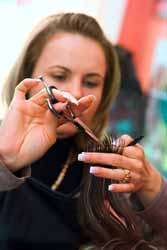
Communication plays a vital role in the haircutting process. Hairdressers must be willing to make suggestions, but also listen to what the client is saying. If the client says they want a “trim,” and the cosmetologist arbitrarily decides instead to take two inches off the length, he will undoubtedly have a very unhappy client on his hands. Even if a cosmetologist thinks he knows better than the client what is best for her hair, he should listen attentively and ultimately do what she asks. That doesn’t mean he can’t make suggestions or offer alternatives, but when a client sits in a cosmetologist’s chair and says “do whatever you want,” that is very seldom the case. There is usually an accompanying “but don’t cut the length, don’t add layers, and don’t cut my bangs too short!”
Cosmetologists must be skilled communicators and also be able to read a client’s body language so that they can ascertain that what they are saying they want and what they mean are one and the same thing.
There are three basic haircuts: solid form, graduation, and layering. All haircuts are a combination of one or more of the three. So if a cosmetologist can master these three cuts, they can literally do any haircut they are asked to do. But besides knowing the mechanics of the three basic haircuts, they must also consider a client’s body style, face shape, hair texture and thickness to achieve the best look for the individual client.
Two people can request the same haircut, but it will most likely look entirely different on each of them. That is where a cosmetologist’s creativity and artistry are most useful. Clients come to cosmetologists for suggestions and advice as much as a new haircut, and the more creative a stylist is, the more loyal her clients will be to her, and the referrals she will get. Advertising helps, but nothing speaks louder than a happy client with a flattering hairstyle.