

 Teach English in Asia
  Cruise Ship Jobs
  Alaska Fishing Industry Jobs
  Sharing Economy / Gig Economy
 Alaska Factory Trawler Jobs – Processing
Factory trawlers are massive (145 – 360-foot) ships, many of which were formerly oil vessels. These converted vessels not only track and catch their own fish, but also process them in huge factories installed below the boat’s trawl deck. Trawlers use high-tech electronic and computer technology to locate targeted species of fish. The skipper’s wheelhouse resembles a video arcade. Behind them, the vessels pull huge, open-mouthed drag nets called trawls, the mouths of which are typically about 100 (but up to 240) feet wide and 35 (but up to 180) feet high. As these nets are dragged through the water, they scoop up any fish unfortunate enough to be in their path.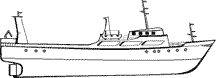
At the end of the net is the cod-end, in which the fish are gathered. The size of the cod-end can vary greatly, but is often about the size of a large school bus. Every few hours the net is hauled up, and the cod-end, holding up to 150 tons of fish, is pulled up onto the trawl deck (the aft portion of the main deck). The fish are then dumped through a hatch to the factory below, where they are sorted, processed, and frozen while the next load is caught.
Most factory trawlers presently fish for Alaska pollock, a whitefish from which the boat either makes fillets (for fish & chips, fish sticks, etc.) or surimi.
What is surimi? Surimi is made by filleting the fish, and then mincing the fillets. The mince is washed over and over, then the water is squeezed out. The end product resembles a doughy paste that can be shaped and flavored to make artificial crab, scallops, etc. Some factory trawlers also make fillets and surimi from cod.
A few boats merely head and gut the fish to be sold in Asia as a low-cost food, while others go after groundfish such as sole or flounder.
Some of the boats also have fishmeal factories on board. Fishmeal (bulk fish food) is made from the unused parts of the fish after they are filleted.
The season for pollock is split into A, B, C, and D seasons. During the Pollock A season, most of the trawlers also process pollock roe (fish eggs) in addition to their regular product.
Pollock Seasons
A – Bering Sea (Jan. – April); Gulf of Alaska (Begins Jan. 20)
B – Bering Sea (June – Oct.); Gulf of Alaska (Begins Mar. 10)
C – Gulf of Alaska (Aug. 25)
D – Gulf of Alaska (Oct. 1)
Roe is the most valuable product harvested by the factory trawler fleet, normally bringing prices four to five times that of the other products! Trawlers also catch quite a few cod, usually starting in February and concentrating on it heavily in the spring when the pollock season ends.
During a successful trip, the best factory trawlers never run out of fish, enabling the factory to run 24 hours a day until the boat’s freezer hold is full. The size of the freezer hold on a trawler depends on the size of the vessel; overall holding capacities vary from 300 to 1,300 tons of finished product. It generally takes about three weeks for a boat to fill up, but this varies from boat to boat and with the seasons. Don’t be surprised to find yourself out at sea for up to two months, without ever seeing land, in some cases.
Once full, most trawlers dock in Dutch Harbor. This factory town on Amaknak Island is located in an inlet of Unalaska Island, about halfway down Alaska’s Aleutian Island chain. Here the product is off-loaded, usually by the processor crew of the boat. Off-load generally takes one to two days, and is generally more strenuous than any other work done on board. While many of the boats do allow their employees a chance to run into town to go to the store or post office, it usually must be done during a worker’s time off. The dilemma? This is also a worker’s only chance to grab some sleep, so don’t expect to have a lot of casual time when the trawler heads to dock.
For those looking to work only during the summer months (e.g., college students), this is not an industry in which you should seek work. Most factory trawler companies don’t hire personnel exclusively for the summer months. On the other hand, if you are willing to take a semester off from school, this could be a great industry for you to work in.
Getting Hired
According to industry representatives, the 80-odd factory trawlers and their supporting industries employ over 6,500 people. In spite of the shortened seasons, most of the companies require a three- to four-month contractual commitment. The industry still looks to hire long-term people; those who express an interest in staying with the industry for awhile stand the best chance of landing a job. But companies have, and will, hire for much shorter periods of time (for example, a single hake season of two weeks) when in a pinch to fill crew positions. It never hurts to try!
When in Alaska, the boats are at dock for a very short period of time. Consequently, it’s probably not worth it to spend up to $800-1,000 for an airline ticket to Dutch Harbor. It makes much more sense to conduct your job search in Seattle if you want to work aboard an Alaska-bound factory trawler. Almost all factory trawler headquarters are located in Seattle.
If at all possible, try to find out information about the different companies from someone who has worked on one of the boats before. Details can vary greatly from company to company. Even boats within one company’s fleet may practice different policies and offer different amenities. You will want to know about pay scales, crew living conditions, the factory environment, and even the work schedules. While one boat’s factory may work 12 hours a day, on a six hours on/six hours off schedule, another may work 16 hours a day, on an eight hours on/four hours off schedule (known as “crazy eights”).
If you do not know anyone who has worked in the industry, try to find someone working on a boat. This can be done during the off season by visiting boats docked in Seattle. Usually workers in this industry are very free with their opinions about the different companies, and will not withhold comments, even about the company for whom they currently work. If you cannot do this, at least be certain to ask as many questions as you can when you call or visit the factory trawler companies in Seattle.
Once you have decided which companies you would like to work for, make an attempt to go into the office of the company, fill out an application, and try to set up an interview. What you wear to the meeting is normally not as important as whether you present yourself as a serious worker. If you do not get the job right away, follow up! The more persistent you are, the better your chances will be if and when an opening arises.
Another often successful tactic, used when you’ve been told that “there are no job openings at this time,” is to go directly to the boat a few days before it leaves and speak with the factory supervisor. He or she will often have a much better idea of the ship’s crew needs than anyone working in the main office. And if that does not work, try being at the boat right before it is about to leave. Often, previously hired people will not show up at the last second, forcing the company to hire whoever is there and ready to leave. If you ever attempt to get hired this way, be prepared to leave RIGHT AWAY. The boat will not wait.
In many cases, it is easiest to get hired during “non-peak” seasons, such as hake season. Once you get your foot in the door and gain some experience, the company will most likely rehire you to work during better, higher-paying, seasons (e.g., Pollock A season). Another option is to get an onshore processing job in Dutch Harbor and keep your eyes and ears open for a factory trawler position to switch to later on.