

 Teach English in Asia
  Cruise Ship Jobs
  Alaska Fishing Industry Jobs
  Sharing Economy / Gig Economy
 Alaska Purse Seining Deckhand Jobs
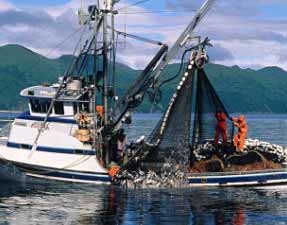
Purse seining is used to harvest large amounts of salmon very quickly and is the most productive of the three main harvesting methods. Seiners use huge – up to 250 fathoms (500 yards) – nets to capture migrating schools of salmon. The top edge of a seine net floats, while the bottom edge sinks toward the ocean floor, forming a large underwater curtain. When a school is located, the net is pulled around by a skiff and drawn into a huge upright tube, ultimately corralling the fish inside. To prevent fish from escaping, the bottom of the net is quickly drawn closed using a “purse line.” The closed 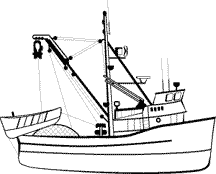 end of the net is then hauled aboard the boat with a hydraulic power block, leaving the floating edge of the net in the water to form a giant “bowl” full of fish. Once brought to the surface, the fish are pumped into the boat’s hold. A good set sometimes produces over 20,000 fish and, under ideal conditions, a good crew can complete a set in as little as forty-five minutes.
Purse seiners require a crew of four to six people who are able to work together efficiently as a team. Greenhorns can find jobs aboard purse seiners more easily than on other boats because of the size of the crew. Green workers typically are offered a quarter or half of the crew share for the first two- to four-day trip, after which the others vote whether to hire the newcomer for the season. The hours are long, the work messy, and workers may come into contact with stinging jellyfish, especially in Southeast. On the other hand, work weeks usually last only two to four days and the pay can be outstanding. Crew shares typically come to $5,000, $10,000, or even $20,000 for two months’ work. However, in poor seasons, some deckhands earn barely enough to pay for their portion of groceries and fuel.
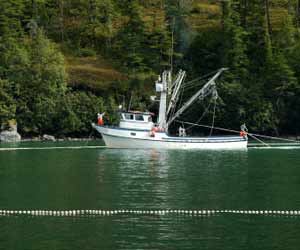
Purse seiners are easily identified by the power skiff (small metal boat), carried piggyback on the stern when not in use. They also have a large round power block that hangs from the boom.
Quick Facts: Purse Seining
Boat size: up to 58 feet
Method: purse seine – surrounding fish with large net and “pursing” up the bottom to form an upside-down umbrella-shaped bowl
Crew members: four to six including skipper
Types of fish caught: all species, but mostly pinks and dogs
Total of Alaska’s salmon caught: 85 percent of the pink salmon, 15 percent of the sockeye, two percent of the kings
Season: S.E. & S.W., July-early September; K.I. & P.N., mid-June-mid-August; Cordova, early June-August
Hours: variable, from long hours to three or four hours a day
Regions: S.E., K.I., P.N., and some S.W.*
Permits issued: S.E.= 420; S.W. = 344; K.I. = 380; P.N. = 209
Average crew share: 7-12 percent, $4,000 – $10,000 for two months
Extreme wages: $3,000 day, $20,000+ season (two months)
Purse Seiner Deckhand duties:
1. Skiffman: in charge of the skiff
2. Deckhand #1: pile nets on deck and cook
3. Deckhand #2: pile nets on deck
4. Deckhand #3: stack cork line
5. Deckhand #4: take care of lead line
*S.E. = Southeast; S.W. = Southwest: Prince William Sound, Cook Inlet; K.I. = Kodiak Island; P.N. = Peninsula/Aleutian Islands; B.B. = Bristol Bay
For a complete list of Alaska purse seining boats and other salmon harvesting job information, go to AlaskaJobFinder.