

 Teach English in Asia
  Cruise Ship Jobs
  Alaska Fishing Industry Jobs
  Sharing Economy / Gig Economy
 Factory Trawlers Employment Positions
The really lucrative positions – fishmaster, ship’s master, deckboss, engineer, and mate – require specific licenses, skills, and/or experience; they are not covered in JobMonkey. For more information, inquire directly with the companies.
Many other jobs are available to hard-working people with little or no previous experience. Production line workers (also called a factory worker, processor, or “slimer”), cook’s helpers, and, on occasion, quality control positions all are entry-level or unskilled positions. Although strenuous and usually monotonous, these jobs typically provide opportunities to earn several thousand dollars a month. Many people who have recently graduated from college or who have taken time off from their regular job or school look for work here, and as they gain experience they can graduate to higher positions such as deckhand, “combie,” and factory foreman.

Pay is based mainly on one’s position on the boat, and then is adjusted for experience. But factory trawlers differ greatly in their methods of calculating employees’ pay. Some factory trawlers pay employees by the hour; others pay a set amount per case of finished product. Most in the industry, however, base pay on a percentage of the vessel’s earnings. Pay for comparable positions will sometimes vary greatly according to both company and individual policies. While all the methods have advantages and drawbacks, it seems that the most money can be made on boats paying a straight percentage of the profits. Remember, however, that in this case, your pay will be totally contingent on the ship making a profit!
Read your contract carefully before you sign it, and ask lots of questions regarding this matter.
Raise policies also vary greatly from trawler to trawler. At times, it seems as if raises are given across the board, while at other times, trying to get a raise is like trying to get blood from a turnip. Just a couple of tips on this subject:
- Some positions on the boat get raises faster than others. Find out right at the start from the factory supervisor, a factory foreman, or a co-worker, which jobs have raise priority.
- Work hard and be smart.
- ASK for raises. You will rarely, if ever, get a raise without asking. Remember the saying: “The squeaky wheel gets the grease.” If that doesn’t work, ask again. If your employers think you’re content with the rate of pay, why would they offer more?
Factory Trawler Deckhand
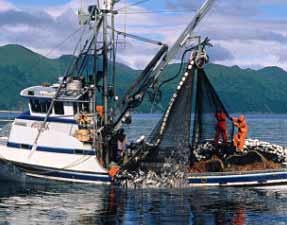
On the trawl deck, the deckboss, or “bosun,” issues orders and the deckhands carry them out. A deckhand’s primary tasks are to set, haul in, and empty the net of fish. Deckhands must also keep the trawl deck neat and operational. Net sewing, maintenance of rigging, block and tackle, as well as other simple repair work often falls to the deckhand. Occasionally, a deckhand will be asked to help out in the factory, or to help keep watch at the helm (“wheel watch”).
Strong, able “novice” candidates occasionally are hired on as deckhands, but previous deckhand or combie experience is usually required. Applicants should be alert, in good physical shape, and willing to work hard. They should also have good judgment and possess the ability to learn quickly. This is a very strenuous job that often is dangerous. Be prepared to continue working when soaking wet, with sub-zero winds whipping you in the face. On a positive note, deckhands are out in the fresh air performing less monotonous work than their below-deck factory counterparts. There are some absolutely beautiful sights to behold while working on deck.
Deckhands typically earn between $4,000 and $10,000 a month.
Combie
A combie is essentially a combination factory worker and deckhand. Combies spend most of their time processing fish below deck in the factory, but get called up if the deckhands need a hand hauling nets or fixing something. This is the common path of advancement from a factory worker to a deckhand position.
Combies typically have some net repair experience or other deck skills, but do not have enough competence or experience to gain the full confidence of the deckboss. Combies should let the deckboss know if they want to become a deckhand so that they might be considered for openings.
Predictably, combies are paid something between a factory worker’s and a deckhand’s wage. About $4,000 to $8,000 a month is typical.
Factory Foreman
The head of the factory on a trawler is known as the production line manager, or the factory supervisor. The supervisor oversees the operation of the processing line and makes all the major decisions for the factory. Usually the supervisor will have assistants known as factory foremen. A factory foreman will be in charge of one of the work shifts in the factory, and ensures that the production line proceeds smoothly during that shift.
Qualified applicants usually are experienced factory workers or have experience managing a production line floor. Line managers manage and motivate factory workers while also working with on-board engineers to communicate with the fishmaster (who controls the net). Together they ensure that there are enough fish in the hold to maintain a steady supply to the factory. Line managers also work with the quality controller, whose job it is to ensure production of a high-quality product.
The factory foreman’s job is extremely important, so they are well paid – typically about $7,000 to $11,000 a month.
Seafood Quality Controller
Quality controllers make sure that the trawler’s product meets uniform standards. Although inspecting surimi is more specialized than inspecting most foods, this is an easily learned, relatively non-strenuous job. It doesn’t require any licensing or special educational background, but nevertheless, it would be helpful to have experience in the food industry or some other related field.
You should note that surimi has been made in Japan for many years, but is relatively new to Americans. While inspecting surimi is fairly easy to learn, the making of high-quality surimi is quite complicated. Those who make the surimi are called surimi technicians, and are headed by the surimi master. Many of the trawlers hire specialists from Japan to make the surimi. On such boats, the quality controller position is also often filled by a Japanese individual, allowing complete communication between this position and the surimi technicians. Quality controllers typically earn between $4,000 and $6,000 per month.
For a complete list of factory trawlers operating in Alaska (including detailed profiles of each), go to AlaskaJobFinder.com.