

 Teach English in Asia
  Cruise Ship Jobs
  Alaska Fishing Industry Jobs
  Sharing Economy / Gig Economy
 Traveling Internationally for your Overseas Job
Your Papers, Please
No, you can’t leave your thick pocketbook or heavy wallet at home.
International travel requires that you keep your papers in order, and in some cases on your person at all times. It’s worth the hassle, though. You won’t regret being organized and on top of your game when an immigration officer interrupts your snoozing on the train to check your passport or when a prospective employer wants to make sure you’ve actually taken all the coursework you boast about.
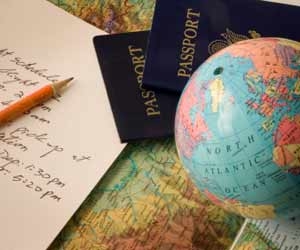
Passport
All international travelers need a passport valid for at least six months beyond their planned date of return to the United States.
Contact your nearest passport agency for information and an application. Make sure you apply well in advance of your planned date of departure because the application process can take several weeks (sometimes longer during busy times). Passports usually are valid for ten years from the date of issue. If you were younger than eighteen when you were issued your first passport, make sure to check the expiration date because these passports expire five years from the date of issue. As a precaution, leave a photocopy of the first page of your passport with a friend or family member at home and carry another copy with you, but be sure to keep it separate from the original.
Passport Photos
If you are applying for a new passport, consider getting some extra passport-size photos taken. (If you have your passport already, it would be wise to get some photos taken anyway.) You will be able to use the American-sized passport photos for any documents you apply for in the US, but if you are applying in the Czech Republic for a work visa, residency permit, a transport pass, or a library card, you will need Czech-sized photos (which are smaller than US passport photos), which can be taken in many spots around the city, including Kodak stores or photos booths that are located in some metro stations.
Not all countries in Eastern Europe require photos for applications, but it is sensible to carry a few spares with you just in case.
International Driver’s License
Driving a car abroad over an extended period may require an international driver’s license. You must be over eighteen and have a valid United States driver’s license. To obtain an international driver’s license, bring two passport -size photos to your nearest American Automobile Association (AAA) office. The license is valid for one year and costs US$10 for members and $15 for nonmembers. Make sure that you become familiar with the different driving laws of the countries you’ll be traveling through, since it’s very likely that they will be different from traffic laws in the United States.
The Student Identity Card
Available at student travel organizations (Council Travel, STA, etc.), the international Student Identity Card can get you sizable discounts on airfares as well as many transportation and admission costs. It also identifies you as a student, which could come in handy when you apply for a work permit. The Youth Identification Card is similar, but for non-students under the age of twenty-six. (Don’t bother going out of your way to get a youth card because your passport proves your age as well as anything.) It’s not as easy, however, to get youth discounts in some areas of Eastern Europe as it is in Western Europe. Also available (at least through STA) is the Teacher card, and whether you are teaching preschool or business English, you can qualify for this card.
College Diploma or Transcript
If you can get original copies of your transcripts or an official document from your college or university stating your date of graduation and degree, bring them. They will come in handy during interviews, especially if you don’t have a teaching certificate. If your degree or a good portion of your coursework is related to the various demands of English teaching, your prospective employer will likely take an interest in you. Or at the very least, you will be able to prove your level of education. If you cannot get original copies, make sure to get notarized photocopies of your documents, a critical requirement for work visas and residency permits. In some cases, however, the notarized copies will still need to be translated into Czech, Slovak or Hungarian. It is easiest and cheapest to do this once you have arrived at your destination.
Teaching Certificate and Resume
A teaching certificate, such as TEFL is the single most valuable document for those looking for work in the English-teaching field in Eastern Europe. If you have one, bring it. Make copies, too, just in case. If you have teaching (or related) experience, an up-to-date resume (or CV in Europe-speak) is essential. Letters of recommendation also will prove helpful, especially if they give your interviewer evidence of your potential or proof of your experience. In an increasingly competitive job market, any of these documents will bolster your chances of getting hired.
Information to Go
Embassies, consulates, and tourism offices offer a wealth of information (most of it free) to prospective travelers. Take the opportunity to get as much information as you can prior to your departure by visiting a nearby office or doing research on their websites. It will save you time, money, and potential hassles later on. Bring notarized copies of your birth certificate, a health insurance card if you have it, notarized copies of your marriage certificate if you are married, (Embassies and consulates for each country are listed in the Visas and Work Permits section. Tourism offices are listed in the individual country sites.)