

 Teach English in Asia
  Cruise Ship Jobs
  Alaska Fishing Industry Jobs
  Sharing Economy / Gig Economy
 Types of Oil Drilling Rigs
Getting down to the basics, there are several types of offshore oil rigs designed to work in a variety of locations, on certain kinds of wells, and differing environments:
- Jackups are moveable drilling structures with bottom supports. Jackups have open-truss or columnar legs in support of their main deck or hull area.
- Platforms cannot be moved like Jackups. They are immobile. Platforms are typically made from steel or cement and are used to drill new development wells.
- Semisubmersibles drilling units, or Floaters, stay afloat offshore on giant pontoons or hollow columns. When filled with water, the pontoons or columns will partially submerge the unit to a desired depth. Floaters are reliable in rough seas and most frequently used for drilling new wells (Wildcat Wells).
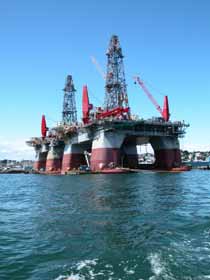
What exactly is a drilling rig? Most rigs rely on several primary systems to get the job done:
- A hoisting System, often referred to as the derrick or drawworks.
- A drive group comprised of motors, chains and compounds.
- A circulating system of pumps, a kelly, drill string, return lines, and pits.
- Well control equipment
Wells are drilled for a variety of purposes. When a new well is drilled in an effort to find new reservoirs it’s called an exploratory well. There are also development wells, which go into already proven oil fields and are designed to maximize oil production from that field.
The most common drilling technique is rotary drilling. It is a method whereby a rotating drill bit is forced downward into the earth to make a hole or wellbore. The drill bit is connected to and rotated by a drill stem, which also provides a passageway through which the drilling fluid (mud usually) is circulated.
A petroleum engineer or expert in the field of drilling could write volumes on the topic of drilling. We just want to give you the basics on JobMonkey.
We’ve talked about the types of rigs, wells, and told you that the most common type of drilling is done by rotary drills. Here’s some information about the way wells are drilled. It’s not always a case of ‘straight down.’
When you hear that a well will be drilled conventionally, it means the well will be drilled straight down vertically to the oil.
Conventional drilling doesn’t always yield the best results. Oftentimes the driller will go down vertically and then make a sharp horizontal turn. Special drill bits are required for this to work. Sometimes the there will be two wellbores drilled, one over the other in fairly close proximity. Steam will be injected from above into the overhead hole which forces oil down into the lower hole facilitating easier extraction.
Slant or directional drilling is when the bit goes down at an angle. We hear about this technique more and more due to environmental concerns. Lets say the oil is in a sensitive area. You could build your rig on a less sensitive area and drill at an angle until you’re underneath that sensitive area. You get the oil without disturbing the environment so much. Multiple angled holes may be drilled from one rig to maximize production from the reservoir. With the type of equipment and technology available today, directional drilling is very precise.