

 Teach English in Asia
  Cruise Ship Jobs
  Alaska Fishing Industry Jobs
  Sharing Economy / Gig Economy
 Smokejumper Forest Fighter Jobs
Smokejumper Duties
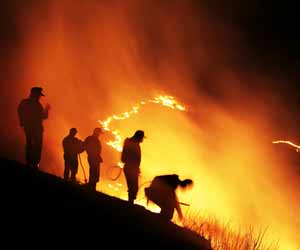
If hotshot crews are the Forest Service’s Marines, then the smokejumpers are the Green Berets. Smokejumpers are firefighting’s lunatic fringe. As if fighting forest fires weren’t adventurous enough, smokejumpers start the day off with a low-altitude parachute jump into the burning forest!
Smokejumpers are flown into hot areas that hotshot crews and other firefighters cannot reach. Usually, the fire is in the early stages of development in an area inaccessible to ground transportation. Smokejumpers jump in groups of two to ten – with about 100 pounds of equipment apiece – and spend three to five days fighting the fire. When finished, they gather together their equipment and pack it out to the nearest access road, which is often many miles away.
Smokejumpers must furnish their own boots, as well as a knife and a watch. Jumpsuits are self-made during training and specialized gear is provided by the Forest Service.
Those working as smokejumpers start at the G-5 level, and contracts run for 180 days or less. Returnees begin at the G-6 level. Hazard bonuses are paid for hours spent fighting uncontrolled wildfires.
Smokejumper Qualifications
Smokejumpers are expected to know how to fight fires before they arrive at training camp. At least one season (three to six months) of wilderness firefighting experience is required of all applicants. This experience must include instruction in basic firefighting techniques. The best way to get this experience is to work as a regular firefighter for the Forest Service, the Bureau of Land Management, or a state forest.
— View Smokejumper Job Postings —
In addition to a season of firefighting experience, applicants must have one year of general, related work experience. For example, successful applicants often have experience as farmers, park rangers, ranchers, or range land managers.
Twelve semester hours of related coursework in forestry, range management, wildlife management, and other relevant academic subjects can be substituted for general work experience; the firefighting experience, however, is mandatory. Previous parachuting experience may be to your advantage, but all smokejumpers are rigorously trained, so it isn’t necessary.
Unlike other jobs with the Forest Service, would-be smokejumpers must pass specific requirements to be considered for employment. Those requirements are outlined below. Furthermore, this elite firefighting group must also attend a “boot camp” where additional testing and training take place.
To be considered for a smokejumping position, applicants must have the following physical characteristics:
- Height: 5’0″-6’5″
- Weight: 120-200 pounds
- Eyesight: at least 20/100 in one eye and 20/200 in the other
- Height-weight proportionate
- Upon arrival at boot camp, applicants must pass the following physical tests:
- 7 pull-ups (hands facing either way)
- 45 sit-ups
- 25 push-ups
- 1.5-mile run in less than 11 minutes
All of these are minimum requirements, and most recruits easily exceed them.
The first month of smokejumping takes place at a boot camp at the base in Missoula, Montana. Beginning in the middle of June, new recruits and returnees undergo rigorous training which includes:
- The physical test described above
- Two pack-out tests carrying heavy packs (one on smooth and one on rugged terrain)
- Mock parachute training, followed by seven increasingly difficult parachute jumps
- Digging, fireline construction, tree climbing, chainsaw handling, crescent saw operation, running, and orienteering (map and compass reading)
Firefighting crews are made up of men and women who love hard work, adventure, and wilderness. Most people have trouble understanding why anyone would take a job as dangerous and demanding as a forest firefighter’s. We asked a number of veterans why they go back every summer, and found that while the adventure and the scenery are both important and the money is good, the best part of the job is the camaraderie. Perhaps because of the long treacherous hours of hard work involved, people who fight fires together often become close friends.
Getting Hired
To apply for a job as a smokejumper contact a smokejumper base directly. Consult the following list for the phone numbers and addresses of all nine smokejumper bases. Find out what smokejumpers do right here.
Alaska Smokejumpers
Box 35005
1513 Gaffney Road
Ft. Wainwright, AK 99703
(907) 356-5541
Boise Smokejumpers
3833 S. Development Ave.
Boise, ID 83705
(208) 387-5426
California Smokejumpers
6101 Airport Road
Redding, CA 96002
(530) 226-2888
Grangeville Smokejumpers
Grangeville Air Center
Route 2, Box 475
Grangeville, ID 83530
(208) 983-1964
McCall Smokejumpers
Box 1026
McCall, ID 83638
(208) 634-0382
Missoula Smokejumpers
Aerial Fire Depot
Box 6, Airport Terminal
Missoula, MT 59802
(406) 329-4893
North Cascades Smokejumpers
23 Intercity Airport Road
Winthrop, WA 98862
(509) 997-2031
Redmond Smokejumpers
Redmond Air Center
1740 SE Ochoco Way
Redmond, OR 97756
(541) 504-7280
West Yellowstone Smokejumpers
WYIFC Box 610
West Yellowstone, MT 59758
(406) 646-7691
Gallatin National Forest
Box 130
Bozeman, MT 59771
(406) 587-6716